By Joseph R. Jaramillo, Vice President, Digital Services, Abba Technologies
Connect with Joseph
Consider an AI assistant helping manage a $50 million infrastructure program.
It identifies a project falling behind schedule, analyzes resource availability, and recommends adding engineering support to accelerate delivery.
Sounds promising.
Except those resources require contractual authorization. The project has funding restrictions. And the proposed changes could affect other projects.
The AI identified the right problem but recommended a solution without understanding the business consequences.
The technology worked. The business decision didn't.
As AI evolves from answering questions to executing tasks, I think this distinction deserves more attention.
Connectivity Isn't Business Intelligence
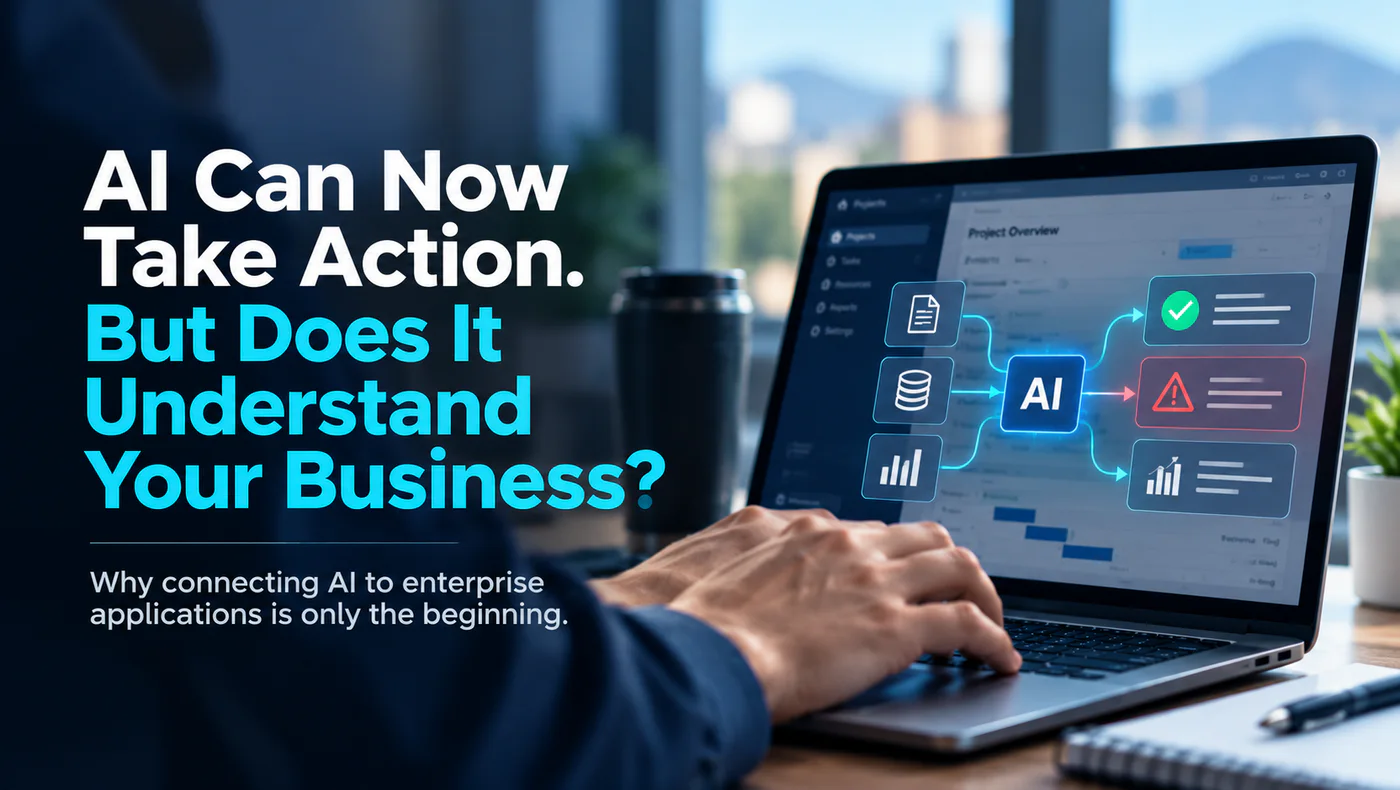
Technologies such as the Model Context Protocol (MCP) are making it easier for AI to interact with enterprise applications, retrieve information, and initiate workflows.
But connecting AI to business systems doesn't automatically mean it understands how an organization operates.
An AI assistant might know how to update a project budget, modify a schedule, or initiate an approval. That doesn't mean it understands when those actions are appropriate.
We're getting better at teaching AI how to use our software. But are we teaching it how our businesses actually work?
What We Learned Building IQbit
This is something we've been exploring firsthand at Abba Technologies.
As we've developed ProjectIQ, our enterprise project management platform, we've also been building IQbit, an embedded AI assistant designed to help users work more effectively within the application.
One of our early realizations was that connecting IQbit to an AI model wasn't enough.
We needed to give it a reliable understanding of how ProjectIQ actually works.
That meant developing structured knowledge around project setup, financial management, reporting, and the relationships between those processes.
We also had to distinguish between explaining an application capability, accessing actual project information, and taking action within the application.
For example, IQbit can help users understand the project setup process, but creating a project involves more than entering information. There are contractual details, financial assumptions, required fields, and authorization requirements that must be respected.
We designed IQbit around documented application capabilities, grounded responses, and defined authorization boundaries rather than allowing AI to improvise how business processes should work.
Importantly, this wasn't about training our own AI model from scratch.
It was about giving AI the right business knowledge, context, and boundaries to operate intelligently within our software.
That experience has influenced how we're thinking about the next generation of enterprise applications.
Applications Need to Understand the Work
Traditional business applications are designed to manage information and enforce processes.
But managing information isn't necessarily the same as understanding what someone is trying to accomplish.
Take a project manager preparing for a client meeting.
An AI assistant could retrieve schedules, financial reports, and outstanding issues.
A more business-aware application could go further, identifying significant developments, highlighting unresolved commitments, and helping prepare a meaningful project briefing.
The difference isn't simply automation. It's connecting information to business objectives.
I believe this is where the next opportunity lies.
Rather than just adding AI to existing applications, we need to think about how applications can provide AI with the business context, relationships, and processes necessary to support real work.
That doesn't mean giving AI unrestricted autonomy.
It means allowing AI to analyze information, prepare recommendations, and assist with activities while the application continues enforcing business rules and appropriate approvals.
Where We Go From Here
As we continue developing IQbit, we're exploring how it can evolve beyond answering questions to helping users prepare work products, identify appropriate actions, and navigate operational workflows.
We're approaching that evolution deliberately.
The goal isn't to build an AI assistant that can do everything independently. It's to build applications that combine AI capabilities with real business understanding.
And I think that's an important distinction for organizations considering how to incorporate AI into their operations.
We've made remarkable progress teaching AI how to communicate with our applications. Now we need to make sure our applications can communicate how the business actually works.
Because the real measure of enterprise AI won't be how many tasks it can execute.
It will be how consistently it helps organizations accomplish the right things.